Meine weiteren Tiere
Mein Nashorn, Matterhorn
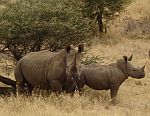
Matterhorn mit Mutter Natal
Matterhorn wurde am 18.8.2004 im LEWA-Wildlife- Conservancy Kenya geboren. Im September 2004 habe ich das Nashornbaby übernommen und ihm den Namen gegeben, da es ein White Rhino mit einem Horn ist und nun einer Schweizerin gehört, gab es nur einen Namen: MATTERHORN. Leider hatte ich noch nie Zeit Matterhorn zu besuchen, doch bekomme ich regelmässig Fotos von meiner Dickhautdame. Sie sei sehr lieb und freundlich zu Menschen. Mehr Fotos in der Galerie.
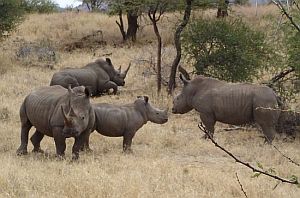 Klein-Matterhorn mit Mutter und Tanten
Update from Matterhorn August 2009
|
Dear
Elspeth, Matterhorn is in good
health. She had her first calf just over 3 months ago, and
since the birth her body has adjusted and is back to normal.
The calf is also healthy and we found out recently that it’s
a male. By the way, Matterhorn holds the record of Lewa’s
youngest rhino mother (she was only 4.8 years old when the
calf was born)! As the seasons change it
is time for your update on Matterhorn. This female white
rhino is now five years old and doing really well.
Matterhorn lives on Sierra 13, in the northern section of
the Conservancy. We caught up with Naahashon Kirimba, one of
the two rangers in the field who look after Matterhorn, to
interview him about your rhino’s recent activities. Matterhorn has been
hanging around with a regular group of friends for quite
some time, including two females named Jacho and Schini, and
a male named Samawati. Recently Schini also had a calf and
left the group, and for now Matterhorn is keeping away from
the others because she is looking after her little one too. Matterhorn doesn’t feed a
lot during the day. She prefers to find a cool area to rest
and then eats in the evening. Her calf is so sensitive that
if it hears anything at all it starts to run away, and
naturally Matterhorn follows. Actually, Naahashon reports
that the calf leading the mother is quite normal for white
rhino.
Naahashon is of the Maasai tribe, and has been working at
Lewa for 13 years. He tells us that everything he has now
was gained because of his career as a ranger. Married, with
a 2 year-old son, Naahashon owns his own shamba and cattle.
He has worked at the Conservancy for a long time, and says
it is a good job, and a great learning experience. He has
seen the way the rhino move about with the seasons and
notices the changes they take on over time. Naahashon
compares looking after rhino with tending to the cattle,
which is something that many Maasai people do all their
lives. In the future, Naahashon says he would like to see
even more protection for rhino and other species, so that
the next generations can see these creatures for themselves.
Naahashon is proud to be involved in Lewa’s wildlife
conservation programme, and says he is happy to be a part of
it for the rest of his life.
Naahashon and the other rangers spend every day patrolling a
2.5 km block of the Conservancy on foot. Equipped with
hand-held radios, a solar panel for charging the battery,
and a pair of binoculars, these men focus on identifying
individual rhino on a daily basis, as well as acting as eyes
and ears for a potential poaching threat, or any other
occurrences in their block. If Matterhorn, or any other
rhino at home in Sierra 13, is not spotted within 5 days,
backup is called in – sometimes including aerial
surveillance. The rangers grow attached to their rhino and
take their jobs very seriously. On behalf of all the
beneficiaries of your generous support, we want to thank you.
Lewa’s core programme of wildlife conservation could not be
possible without sharing the proceeds of our progress with
hardworking rangers like Naahashon. With his community
behind us as well as your caring consideration, Lewa’s rhino
are thriving. So far in 2009, we have had twelve births (9
black and 3 white rhino), bringing the total population to
112: 68 black rhino and 45 white. With over 10% of Kenya’s
black rhino population, we are proud to tell you that there
has never once been an incident of poaching on our grounds.
This is thanks to our dedicated rhino surveillance teams,
and to people like you who continue to invest in the work
that we do.
|
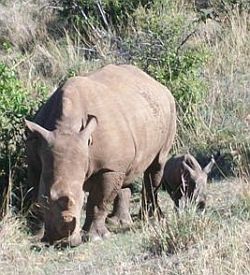 Matterhorn mit Sohn
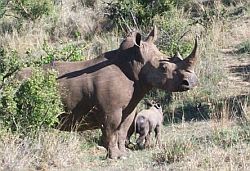 jüngste Nashornmutter Matterhorn mit Sohn
Update from Matterhorn Februar 2012
Dear Elspeth:
Habari yako? (How are you?). It has been a while since we last wrote to you and for that we apologize. Seasons have changed on Lewa and a lot has happened since our last update.
Matterhorn is now seven years and five months old and has really grown since you last heard about her. Her birthday is on the 17th of August.
Most female white rhinos are very social, not very temperamental, often moving and grazing together in groups. They mostly do not defend territories. Matterhorn is a fairly calm female white rhino and rarely initiates an attack unless provoked. She spends the majority of her time with her only calf June and their friends Gordon, Jakwai and Dominique. We hope she will be giving birth to more calves in the near future.
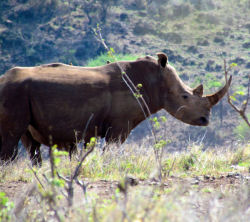
Matterhorn
Matterhorn loves to wallow in the mud especially in the evening when the surrounding air is cooler. Wallowing allows her temporary relief from swarms of biting flies, helps reduce her body temperature since she does not have any sweat glands and also gives her some protection from the sun. However since last October, Matterhorn has been wallowing less and less because we received long rains. The temperatures are much cooler on Lewa and there is reduced fly & parasite activity.
Thanks to the heavy rains, the vegetation on Lewa has been plentiful and all our rhinos, including Matterhorn, have a lot to feed on. Before the rains came, Lewa was so dry that the wildlife team planned on introducing a feeding programme particularly focused on white rhinos who are the ones affected the most by drought.
In the last two years, Lewa intensified its security measures to tackle rhino poaching. As you might be aware, Lewa lost four rhinos to poaching since 2009, which was a devastating blow to all of us. The increase in rhino poaching is caused by the rising value of rhino horn. At the moment, the value of rhino horn is at its all time high, selling more than gold on per-weight basis. This is fuelled by their use in the traditional medicine systems of many Asian countries, from Malaysia and South Korea to India and China, to cure a variety of ailments. In Traditional Chinese Medicine, the horn, which is shaved or ground into a powder and dissolved in boiling water, is used to treat fever, rheumatism, gout, and other disorders. (However, it is not, as commonly believed, prescribed as an aphrodisiac).
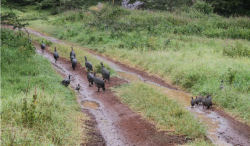
Green vegetation on Lewa
Lenient punishment for poachers especially in Kenya has not helped in the fight to curb this practice. Many rhinos have been killed by repeat poachers, often within weeks of their arrest and paying the meagre fines that are defined by the law. For instance, a poacher caught with rhino horn could pay a fine of as little as $200 whereas a kilo of the same horn will fetch thousands of dollars on the black market.
Nevertheless, 2011 was a good year for Lewa. We did not suffer any poaching incidents and our security team managed to stop two poaching attempts. It was also a year of celebration as we had 15 births (9 black and 6 white rhinos), bringing the total population to 127: 67 black rhinos and 60 whites. In 2012, we will continue to invest significant time, energy, funds and intellect into mitigating the threat to the Conservancy’s founding species. The battle however will certainly not be won in the field alone and engagement with partners to develop avenues for lobbying market countries in the Far East will be perpetuated as a focus of our efforts.
We thank you most sincerely for your continued support to Lewa’s rhino programme. The Lewa team wishes you a joyous new year! Mwaka mpya wenye fanaka! (May the New Year bring you happiness and prosperity!)
Yours Sincerely,
The Lewa Team
Mitteilung über Matterhorns Tod vom 13.04.2012
Dear Elspeth,
It is with profound regret that we write to inform you of the death of Matterhorn which occurred on the 4th of April, 2012. She was eight at the time of her death, and was set to deliver her second calf.
Matterhorn had been reported missing for a few days. When female rhinos are near their calving time, they search for a silent, secluded place where they can go give birth with minimal disturbance. Matterhorn had therefore moved away from her regular territory making it difficult for our team to trace her movements.
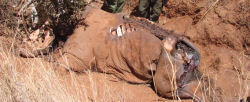
After a long search Matterhorn’s carcass was discovered in a hidden gulley. Predators had already ravaged much of the carcass, but it was clear that she was the victim of a poaching attack. Her horns had been removed, and a bullet wound was still visible. Her three-year old male calf, June was also attacked and has since been treated by our Vet unit.
This is the fourth poaching incident we have had on Lewa. Investigations are still on going to establish more facts that will help us track down the poachers.
Matterhorn’s death is very unfortunate. Her life was quite interesting; she made history by giving birth at the age of five, the youngest ever for a white rhino on Lewa. She was calm and easy to approach, and fiercely protective of her calf, June.
We remain grateful for the support you have given Matterhorn over the years. The Rhino Naming Programme is a vital part of keeping our rhinos safe on the Lewa Wildlife Conservancy and your support towards rhino conservation is deeply appreciated.
Rest in peace Matterhorn.